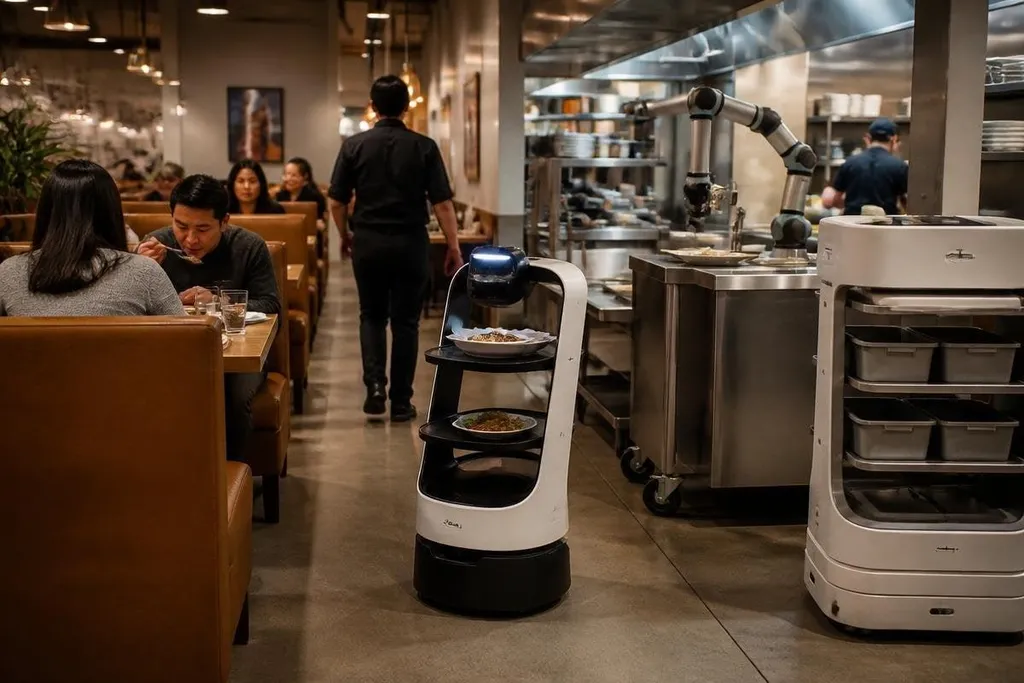
A restaurant robot can look useful in a 30-second video and still fail during a lunch rush. The real test is narrower: can it repeat one job safely, for a full shift, at a cost the restaurant can carry?
- Kitchen work needs repeatable motion, not a single successful run
- Service robots must handle people, spills, tight spaces, and changing orders
- Buyers need proof of uptime, cleaning needs, repair time, and total cost
The job matters more than the shape
The race includes machines with different bodies because restaurants have different tasks. A food runner needs safe movement near people. A kitchen arm needs accurate motion near hot surfaces. A dish-handling system needs a plan for water, heat, and uneven loads.
That makes the phrase “restaurant robot” too broad to guide a purchase.
A buyer should start with one task: carrying trays between a pass and a table, loading a dishwasher, or moving ingredients between work areas. The machine should then be judged against the time, space, and safety rules of that task.
A useful test asks for four numbers: payload in kg, runtime in hours, movement speed in metres per second, and the time needed to recharge or swap a battery. Those figures do not settle the purchase, but they show whether the machine fits the shift.
The hard part is an ordinary service
Restaurants rarely offer a clean test site. Floors get wet. Chairs move. Staff cross the robot’s path. Orders change, trays vary in weight, and a doorway may be open one minute and blocked the next.
A robot that works only in a fixed route has a narrow use. That can still be useful if the route stays fixed and staff can recover the machine without calling a specialist. The buyer needs to see what happens after a blocked path, a low battery, a dropped item, or a sensor covered by grease.
The recovery process matters as much as the first run. Ask whether a worker can restart the robot from a screen, how long that takes, and what happens when the robot stops outside its assigned area. A system that saves labour during normal service can lose that gain if every fault needs a remote operator.
Safety also needs detail. Look for the stop control, the robot’s speed near people, its detection range, and the steps for cleaning around sensors and wheels. A safety claim without a test method leaves too much for the restaurant to guess.
The business case has more than one price
The purchase price is only one line. A restaurant also needs to count software fees, installation, staff training, battery replacement, service visits, and the work needed to change the floor plan.
The right comparison is the cost of one completed task. If a robot carries meals, measure completed trips per hour, failed trips, staff time spent helping it, and the hours when it is unavailable. If it handles food, add cleaning time and the checks needed before service.
Restaurant buyers need the machine’s task beside the shift it serves: a tray carrier may finish a route, yet staff still handle loading, spills, and blocked doors. A report from Robot24 can put a named robot, site, date, and result beside that claim, so the pilot that follows starts with facts rather than a demo clip.
A short pilot should use the same route, workload, and staffing pattern as a normal shift. The record should include stops, human interventions, damaged items, cleaning time, and repair delays. A demo proves that a task can happen once; a pilot shows what the task costs across repeated service.
A buying check
Use these questions before signing a contract:
- Name the task and set a pass mark, such as completed trips per hour.
- Record the payload, speed, runtime, recharge time, and turning space.
- Ask for results from a site with people, spills, blocked paths, and changing loads.
- Price software, batteries, repairs, training, cleaning, and floor changes.
- Set a response time for faults and name the person who can fix them.
- Define what data the robot records and how long the supplier keeps it.
The global race will produce more machines, but restaurants don't need more shapes on a showroom floor. They need a robot that repeats one paid task, fits the kitchen, and keeps working when service stops being tidy. Until suppliers publish that evidence, the sensible buyer should treat the demo as the start of the test, not the result.